Commercial · Lynden
Panic & Exit Hardware in Lynden
The new access-control reader at the staff entrance works fine going in, but nobody has sorted out the door's exit side, and right now a card reader and a pushbar exist as two separate ideas.
Panic & Exit Hardware
In plain words
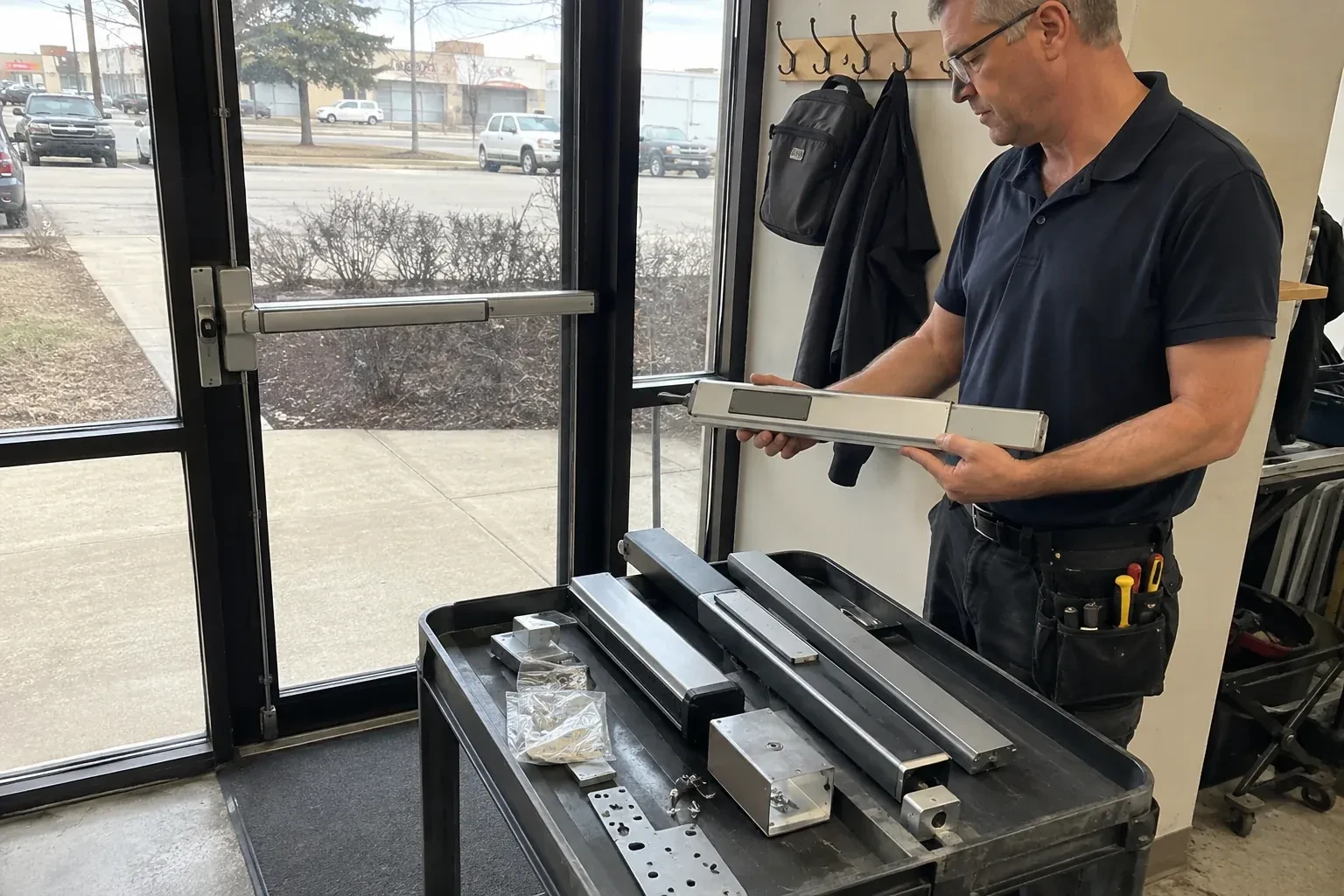
Electrified exit hardware adds a layer without changing the basic behaviour of the door: a person inside can still leave under one motion of the hand, every time. A request-to-exit switch tells an access-control panel that the pushpad or crossbar was actuated, usually paired with a door-position contact so the panel can also tell a normal exit from a forced or propped door. Electric latch retraction lets a fire-rated opening behave like a push-pull door for staff, provided it relatches automatically on a fire-alarm signal, since that kind of door never carries a mechanical dogging function. An alarm module sounds when the device is used.
How the visit goesAfter the fit-out, the gym floor now holds more people than the old office space ever did, and the exit door at the back still has the same turn-lock it had when the room held desks.
Lynden
How the visit goes
Is this door part of a pair?
Single doors and pairs get assessed differently from the first look. On a pair, the locksmith checks whether a mullion currently splits the opening, whether a coordinator is already fitted, and whether the leaves close independently or in a set order. This decides whether the project is a straightforward device swap on each leaf or something larger, such as removing a mullion and fitting a compatible replacement latching arrangement to turn two narrow doors into one wide exit. Getting this right at the assessment stage avoids ordering hardware for a single door when the opening is really two leaves working together.
Recording what was fitted
The visit closes with a written account of the work: which device went on which door, its type and rating, the outside trim fitted, any electrified function added, and the tests the assembly passed. This record travels with the building rather than staying in the locksmith's memory, so a fire inspector, an insurer or a new manager reviewing the space later has a clear account of the exit hardware and when it was fitted.
A door that opens under one motion, every time
What the space has afterward is straightforward: anyone inside can leave through that door with a single push on the crossbar or touchpad, no key, no second step, no need to remember which way a lock turns. Staff can be shown the motion once and it stays intuitive, because that is exactly what the hardware is built to do. Outside, entry still works the way it was set up to, through the trim chosen for that door, entirely separate from the exit function inside.
Panic & Exit Hardware
In the van
- Door closer
- Through-fixings and mounting hardware
- Installation template and jig
- Strike and reinforcement
- Coordinator for door pairs
What affects the quote
Same fees day, night or weekend
1Device family required
A rim device suits many single doors with modest work. A mortise or vertical-rod device, or hardware built to a fire-exit listing, takes more preparation and generally more hardware, which the quote reflects.
2Condition of the existing hardware
A device that only needs adjustment, cleaning and new fasteners costs less in labour than removing a seized or badly worn device and fitting a replacement in its place.
3Number of openings involved
One door with a single device is the simplest case. A building with several affected exits, such as doors from a stairway plus an assembly-room exit, is quoted as the sum of each opening's own work.
Panic & Exit Hardware: questions
How is panic hardware different from fire exit hardware?
Panic hardware and fire exit hardware share the same push-to-release action, but fire exit hardware is additionally tested and listed for use on a fire-rated door assembly. That extra listing matters because a fire door has to keep an active latch bolt at all times; it cannot carry a mechanical dogging function the way ordinary panic hardware sometimes can, so the two are not interchangeable on a rated opening.
How is occupant load actually counted for this decision?
Occupant load is calculated from the floor area and the intended use of the room, using published factors for that occupancy type, rather than a headcount taken on a busy night. A building official or a locksmith familiar with the calculation can work through it for a specific room, and the result is what decides whether the exit doors serving that room need a releasing device.
Does a retrofit into an older building work the same way as new construction?
The device and trim choices are the same, but a retrofit usually has to work with a door and frame that already carry someone else's old hardware preparation. Reading what holes and reinforcement already exist, and choosing a device that can use or cleanly replace them, is a bigger part of a retrofit than of a new opening built with the hardware in mind from the start.
Commercial Locks
- Master Key System DesignA dental office wants the front desk to lock up at night without ever holding a key to the room…
- Access Control InstallationThe team has grown past the point where one shared key still makes sense.
- Commercial-Grade Lock ReplacementThe key to the office entrance turns with almost no resistance now, and some mornings the deadbolt…
Panic & Exit Hardware near you
Lock work in Lynden is rarely just one thing. A lockout often reveals a worn cylinder; a rekey is a good moment to fix a strike that never lined up. The services below are described one at a time, but a locksmith at your door will happily point out anything else worth doing while he is there.