Commercial · Hamilton
Commercial-Grade Lock Replacement
The key to the office entrance turns with almost no resistance now, and some mornings the deadbolt does not fully retract until someone jiggles the handle and tries the key again.
Commercial-Grade Lock Replacement
In plain words
A great deal of what happens during this service is choosing the right category of hardware before a single screw comes out. Storefront glass and aluminum doors call for a narrow-stile lock or a hookbolt rather than the mortise body a solid wood or hollow-metal door would take, and a door serving a busy exit route may need listed exit hardware regardless of what was on it before. The locksmith identifies which category the opening belongs to, sources hardware built for it, installs it to the door's existing preparation, and confirms the finished lock operates correctly from both the public and the staff side.
How the visit goesThe electric strike buzzes the moment the receptionist presses the release button, but the door still needs a shoulder to get past the latch, as though the two pieces were never matched.
Hamilton
How the visit goes
Checking for a fire rating or an exit requirement
Some commercial doors are part of a fire separation or a required exit route, and that status changes which hardware is legal to install on them. The locksmith looks for a fire label on the door and frame, checks whether the opening serves an assembly space or a high-occupant-load area that calls for listed, push-type release hardware, and confirms whether the door is required to close and latch on its own. None of this is guesswork; it is read directly off the door, its label, and the building's own occupancy information.
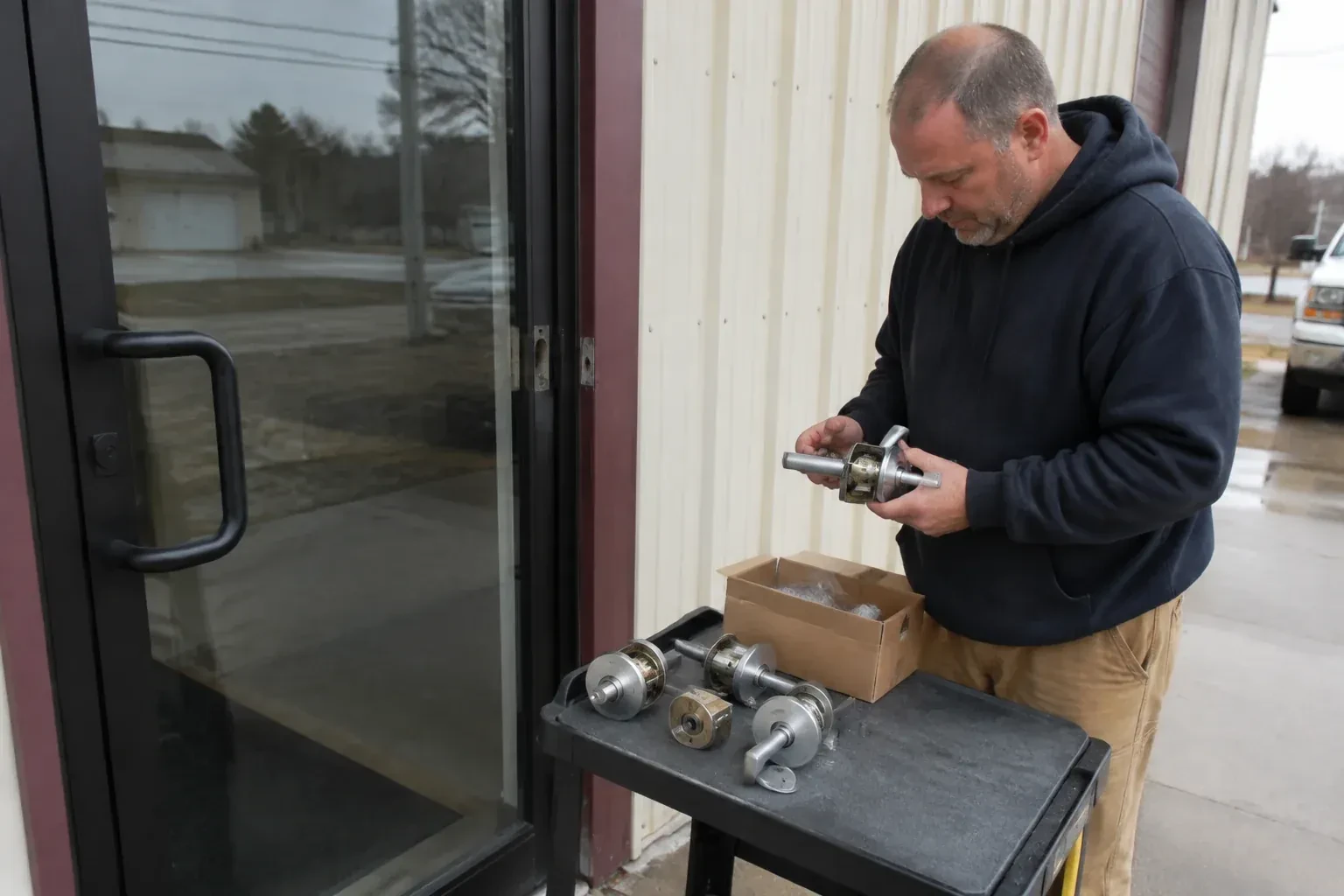
Removing the old hardware cleanly
The existing lock, cylinder and strike come out without enlarging the door's mortise pocket or bore, since a clean prep is what lets the new hardware seat correctly. Any hardware that was previously mismatched to the door, an incorrect backset or a strike screwed in at an angle, is noted so the business understands why the last repair may not have held. The old hardware is set aside for the business to keep, dispose of, or use as a reference for other doors still running the same outdated lockset.
One key system instead of a patchwork
Where the visit brought hardware onto a shared master or interchangeable-core system, the business now has one coherent structure instead of a different cylinder on every door. A master key opens what it is supposed to, sub-master and change keys are limited to their own doors, and the key-control log reflects exactly who was issued what. The next time a lock needs attention, whoever handles it can read that log rather than guessing at what system, if any, the previous hardware belonged to.
Commercial-Grade Lock Replacement
In the van
- Key cutting and coding machine
- Hookbolt and deadlatch hardware
- Mortise prep and installation tools
- Key-control log and tags
- Narrow-stile storefront lock
What affects the quote
Same fees day, night or weekend
1Key-control documentation
Setting up or updating a written key-control log, recording who holds which key and which doors share a system, is a small but distinct task the quote can name separately from the physical hardware work.
2Number of doors involved
One entrance is the simplest case. Bringing several doors, or several branch locations, onto matching hardware or one key system in the same engagement is priced across the whole set rather than door by door in isolation.
3Interchangeable-core hardware
Interchangeable-core cylinders cost more up front than standard ones but reduce the cost of every future rekey, since the business can swap cores itself. Whether that trade-off suits you shapes which cylinder type is quoted.
Commercial-Grade Lock Replacement: questions
Do you replace hardware after an attempted break-in even if the door still locks?
Yes, and it is worth having it checked even when the door still appears to function. A cylinder that was drilled at, pried or struck can be weakened internally without showing it externally, and a bent strike or a cracked frame around the lock can let a door appear locked while offering far less resistance than it should.
Can you upgrade hardware without re-cutting the door or frame?
In most cases, yes. Replacement hardware is chosen to fit the door's existing mortise pocket, bore pattern or narrow-stile prep, so the visit does not usually involve altering the door itself. Re-cutting only comes up when the business specifically wants to change hardware type, for example moving from a knob-and-deadbolt pair to a single mortise lock body.
Can you install a restricted or patented keyway?
Yes. A restricted keyway limits duplication to keys cut through the manufacturer or an authorized distributor rather than at an ordinary hardware counter, though the exact registration and proof-of-entitlement steps vary by system; a patent-protected keyway adds a further, legally backed layer of control on top of that. This is a common step for a business tightening key control after a lost key or staff turnover.
Commercial Locks
- Master Key System DesignA dental office wants the front desk to lock up at night without ever holding a key to the room…
- Access Control InstallationThe team has grown past the point where one shared key still makes sense.
- Panic & Exit HardwareThe new access-control reader at the staff entrance works fine going in, but nobody has sorted out…
Commercial-Grade Lock Replacement near you
Use this list to find the lock service that fits your situation in Hamilton. Openings for lockouts. Rekeys and lock changes for new owners and departing tenants. Deadbolts and high-security hardware for people who want more from their door. Commercial hardware and master keys for businesses. Safes. Keys of every kind.