Car keys · Hamilton
Motorcycle & Scooter Keys
The key still opens the seat and unlocks the fork, but at the ignition it needs a slow half-turn and a small lift before the switch engages, a habit that has crept in over years of daily starts.
Motorcycle & Scooter Keys
In plain words
What is actually possible depends on whether a working key still exists somewhere. If one does, even a spare kept by a family member or a dealership record of the code, a fresh key can usually be cut or duplicated directly from it. If every key for the machine is gone, the locksmith reads the lock itself, translating wafer depths into a cut, or, on a machine with an immobiliser, pairs a new transponder where that system allows it, since some instead need the whole unit replaced. Either route aims for a key that starts the engine and operates the other locks the owner wants included.
How the visit goesTwo keys came with the scooter: one for the ignition and steering, an entirely different one for the seat and the storage compartment underneath it, so opening the seat means carrying twice the metal.
Hamilton
How the visit goes
Confirming who is asking
Before any lock is touched, the locksmith confirms that the person requesting a key has a real connection to the machine: vehicle registration, an insurance document that matches the plate, or a bill of sale for a recent purchase all work. Where paperwork is not on hand, a dealership record, a family member who can vouch for the owner, or a photo of the machine alongside identification often fills the gap. This step takes only a few minutes and stands ahead of any cutting, decoding or programming, since a working key is something that should only ever go to the person meant to hold one.
Decoding a lock with no key at all
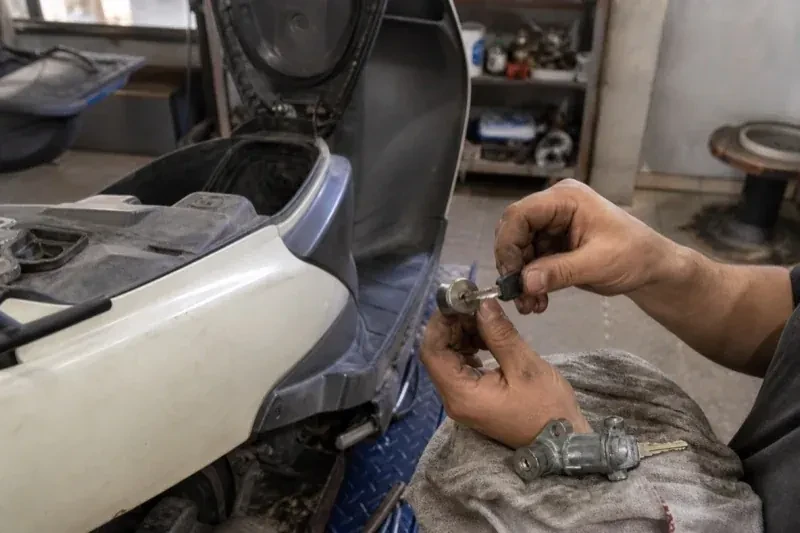
Without any key to copy, the lock has to speak for itself. The locksmith picks the cylinder and reads each wafer's resting depth with feeler tools or a small scope, or uses a decoder built for that keyway, translating what is found into a cutting code. A key is then cut to that code and tested in the lock before being trusted on the ignition proper. This route takes longer than copying an existing key, since every wafer has to be read individually, but it produces a key that matches the lock exactly rather than an approximation.
A key set that covers the whole machine
Where the locks are compatible, the visit ends with them all answering to the same key: ignition, steering, seat and, where fitted, the fuel cap or a storage compartment. Before leaving, each one is opened and closed again with the owner watching, so there is no guessing about which key does what. Carrying one key instead of two or three is a small change, but it is the detail most owners mention afterward, since a single blade on the ring is one less thing to sort through at the pump or on the side of the road.
Motorcycle & Scooter Keys
In the van
- Wafer lock decoder
- Code-cutting machine
- Replacement ignition or steering lock
- Pick and tension tools
- Transponder programming unit
What affects the quote
Same fees day, night or weekend
1Make, model and age of the machine
Make, model and age decide how common the keyway and blank are. A widely used platform is usually the more straightforward case; an uncommon or older machine can take longer to source parts for.
2Number of locks on the machine
A single ignition lock is the simplest case. A machine with a separate seat, fuel cap and storage lock involved is a longer visit with more hardware to read, cut and test.
3Weather affecting a seized lock
A lock seized by cold, ice or dried-out grease from a season of storage takes patient thawing and working before a key can be tested against it, which a winter call reflects.
Motorcycle & Scooter Keys: questions
What should I have ready before you arrive?
The make, model and year if known, the VIN if it is accessible, which locks are involved, and whether the engine cranks but does not start, which can point toward an immobiliser issue among other ordinary starting-system causes. Mentioning whether any key at all still exists, even a broken or poorly cutting one, changes what equipment comes along, since working from a key is a different job than decoding a lock with nothing to reference.
Do you need the vehicle's VIN to make a key?
It helps but is not always required. The VIN can confirm the exact model and sometimes points to a factory key code on file, which speeds up cutting a key without reading the lock from scratch. Where the VIN is not available or does not lead anywhere useful, the locksmith works directly from the lock or an existing key instead, so a missing VIN slows the process rather than stopping it.
Can you cut a key for an older or vintage motorcycle?
Yes, provided the lock or an existing key survives to read from. Older mechanical locks are generally simpler than current wafer or transponder systems, and a locksmith familiar with vintage keyways can often decode or duplicate them the same way as a newer lock. Where a replacement lock is genuinely needed rather than a key, sourcing period-correct hardware can take longer than the key work itself.
Car Keys
- Car Key ReplacementMinus twenty outside, the fob button does nothing, and the door keyhole has a crust of road salt…
- Spare Car Key DuplicationThe proximity fob has ridden in a pocket for years, the range feels shorter than it used to, and a…
- Key Fob ProgrammingA fob went missing weeks ago somewhere between a coat pocket and a parking lot, and a spare has…
Motorcycle & Scooter Keys near you
Use this list to find the lock service that fits your situation in Hamilton. Openings for lockouts. Rekeys and lock changes for new owners and departing tenants. Deadbolts and high-security hardware for people who want more from their door. Commercial hardware and master keys for businesses. Safes. Keys of every kind.